Traditional markets are among the easiest places to encounter everyday Korean food, regional produce, household goods, and small independent businesses in one visit. You do not need a guide, but knowing how payment, ordering, market days, and vendor hours work will make the experience considerably easier.
Information and official links in this guide were checked on June 11, 2026. Individual vendors set their own hours and closing days, so confirm details shortly before visiting rather than relying on a market’s general opening time.
At a glance
| Question | Practical answer |
|---|---|
| What is a traditional market called? | Jeontong sijang (전통시장), meaning traditional market. Signs may simply say sijang (시장), or market. |
| Is admission required? | No. Traditional markets are public shopping areas. |
| Do vendors accept cards? | Some do, but acceptance varies by stall and foreign cards may not always work. Carry small-denomination KRW cash. |
| Is bargaining expected? | Usually not for prepared food or clearly priced products. Polite negotiation may be possible for clothing or multiple-item purchases. |
| When should I go? | Late morning through lunch is a practical starting point. Produce and seafood markets may become active earlier. |
| Are markets open every day? | Permanent markets often operate most days, but individual shops close independently. Five-day markets open only on designated dates. |
| How long should I allow? | About 60–90 minutes for browsing and a snack, or two to three hours if you plan to eat and shop. |
What counts as a traditional market in Korea?
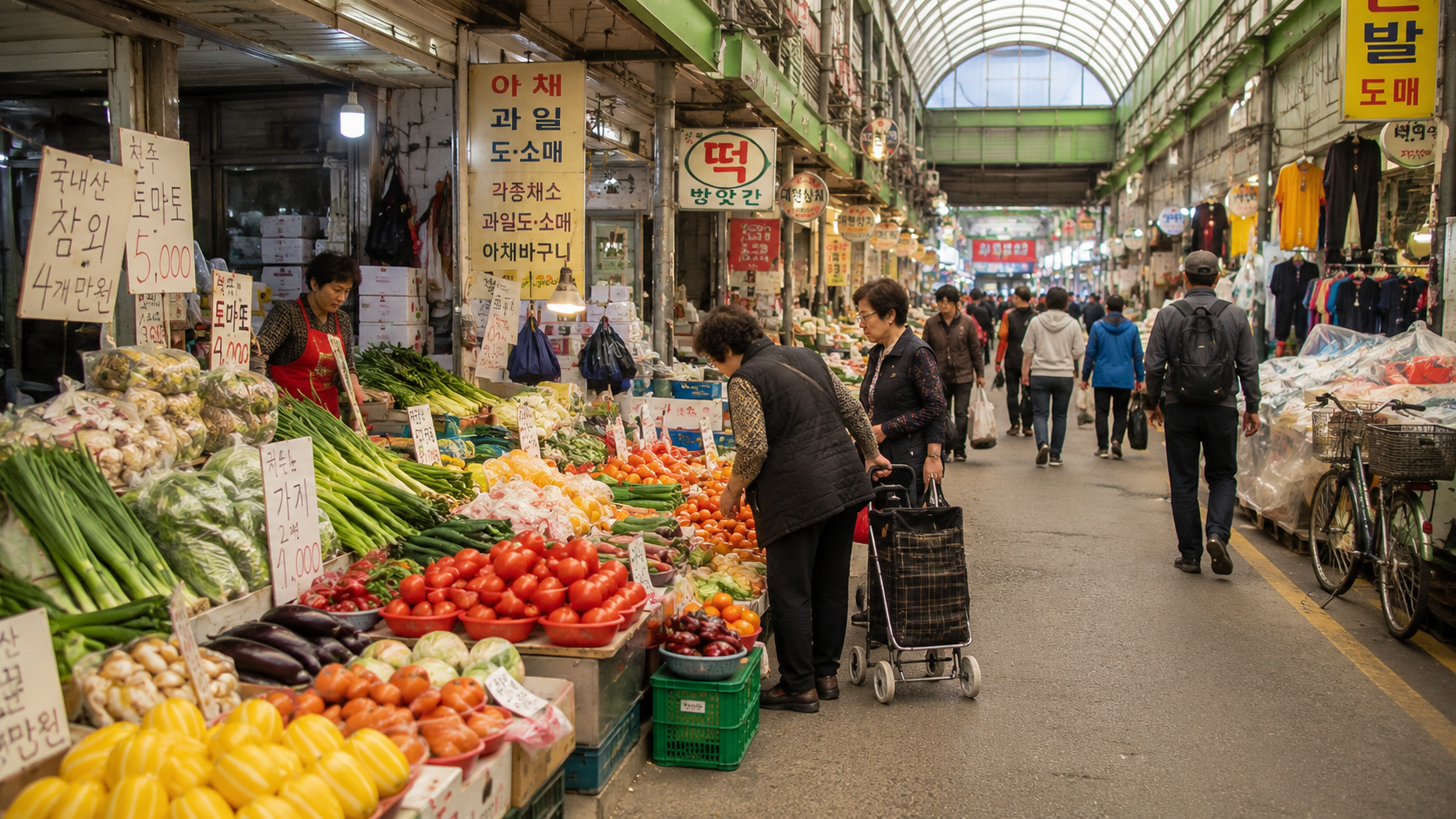
Korean markets range from covered neighborhood arcades to wholesale districts and open-air markets held only several times a month. A single market may contain produce sellers, fishmongers, butchers, fabric shops, restaurants, snack counters, repair services, and household-goods stores.
Large markets in Seoul and Busan receive substantial tourist traffic, but they still function as working commercial areas. Handcarts, delivery motorcycles, wet floors, stacked boxes, and early-morning deliveries are normal. Keep to one side of narrow lanes and do not block a stall while taking photographs.
Permanent markets
A permanent market operates from a fixed location throughout the year. It may occupy several buildings and streets, with each section keeping different hours. Namdaemun Market’s official directory, for example, separates clothing, accessories, children’s wear, kitchenware, food, agricultural products, flowers, crafts, jewelry, watches, and cameras. The market association also publishes separate business information because there is no single schedule covering every shop. Check the official Namdaemun Market website before making a special trip.
Five-day markets
An oiljang (오일장), literally a five-day market, opens on dates ending in particular numbers. A schedule described as “2 and 7,” for example, usually means the 2nd, 7th, 12th, 17th, 22nd, and 27th of each month.
Do not interpret “five-day market” as a market that remains open for five consecutive days. The designated date is called jangnal (장날), or market day. Schedules can be affected by holidays, weather, local events, or months without a later matching date. Confirm the current calendar through the relevant city, county, or official tourism office.
Major traditional markets to consider
These markets are useful starting points, but they offer different experiences. Choose according to what you want to eat or buy rather than trying to visit every famous market.
Gwangjang Market, Seoul: prepared food and textiles
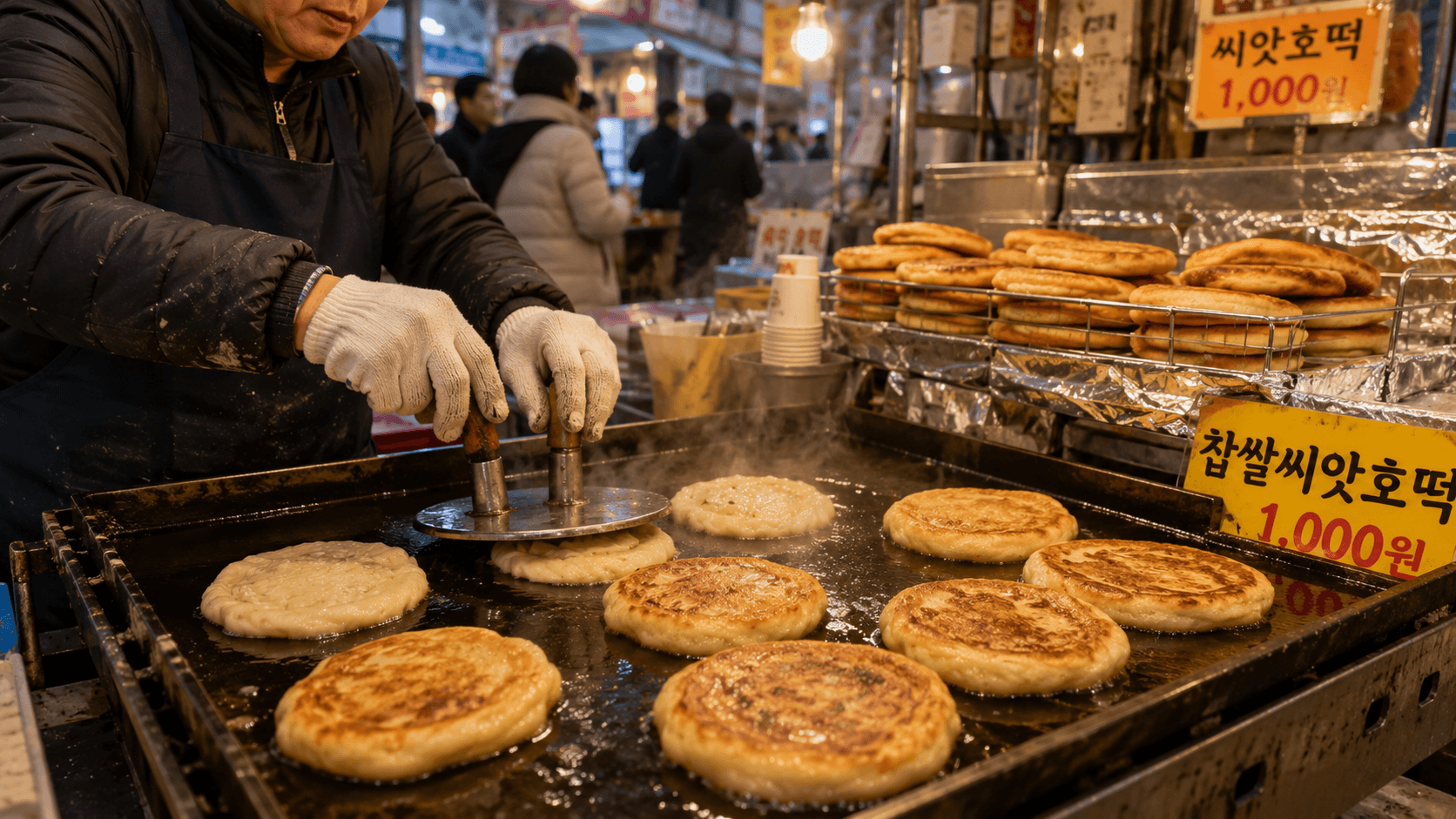
Gwangjang Market (광장시장) is a practical choice for visitors who want a concentrated food-stall experience. Commonly encountered dishes include bindaetteok (빈대떡, mung-bean pancake), gimbap (김밥, rice and fillings wrapped in seaweed), noodles, dumplings, and yukhoe (육회, seasoned raw beef). The wider market also includes fabric, bedding, and hanbok-related businesses.
The food lanes can become crowded around lunch, dinner, and weekends. Walk through once before ordering, check posted prices, and avoid stopping abruptly in the central aisle. Raw beef, raw seafood, and dishes containing sesame, shellfish, wheat, or soy may not suit every traveler; ask before ordering if you have dietary restrictions.
Vendor hours differ by section. Consult the Gwangjang Market association website for available market information, but confirm with an individual business when visiting for a particular shop.
Namdaemun Market, Seoul: goods, specialist lanes, and local meals
Namdaemun Market (남대문시장) is better suited to broad shopping than a single street-food circuit. Its lanes and buildings sell clothing, accessories, kitchenware, imported foods, stationery, agricultural products, flowers, crafts, and other specialist goods. Food areas include restaurants and lanes associated with particular dishes.
The main difficulty is scale. Save the Korean name, address, building, and shop number of any specific business before arriving. A shop described as being “at Namdaemun Market” may be inside an arcade that is difficult to locate from the street.
The official market association lists product categories, facilities, directions, and separate business-hour information. As verified on June 11, 2026, the association treats operating schedules by shopping building rather than promising one market-wide opening time.
Jagalchi Market, Busan: seafood and harbor atmosphere
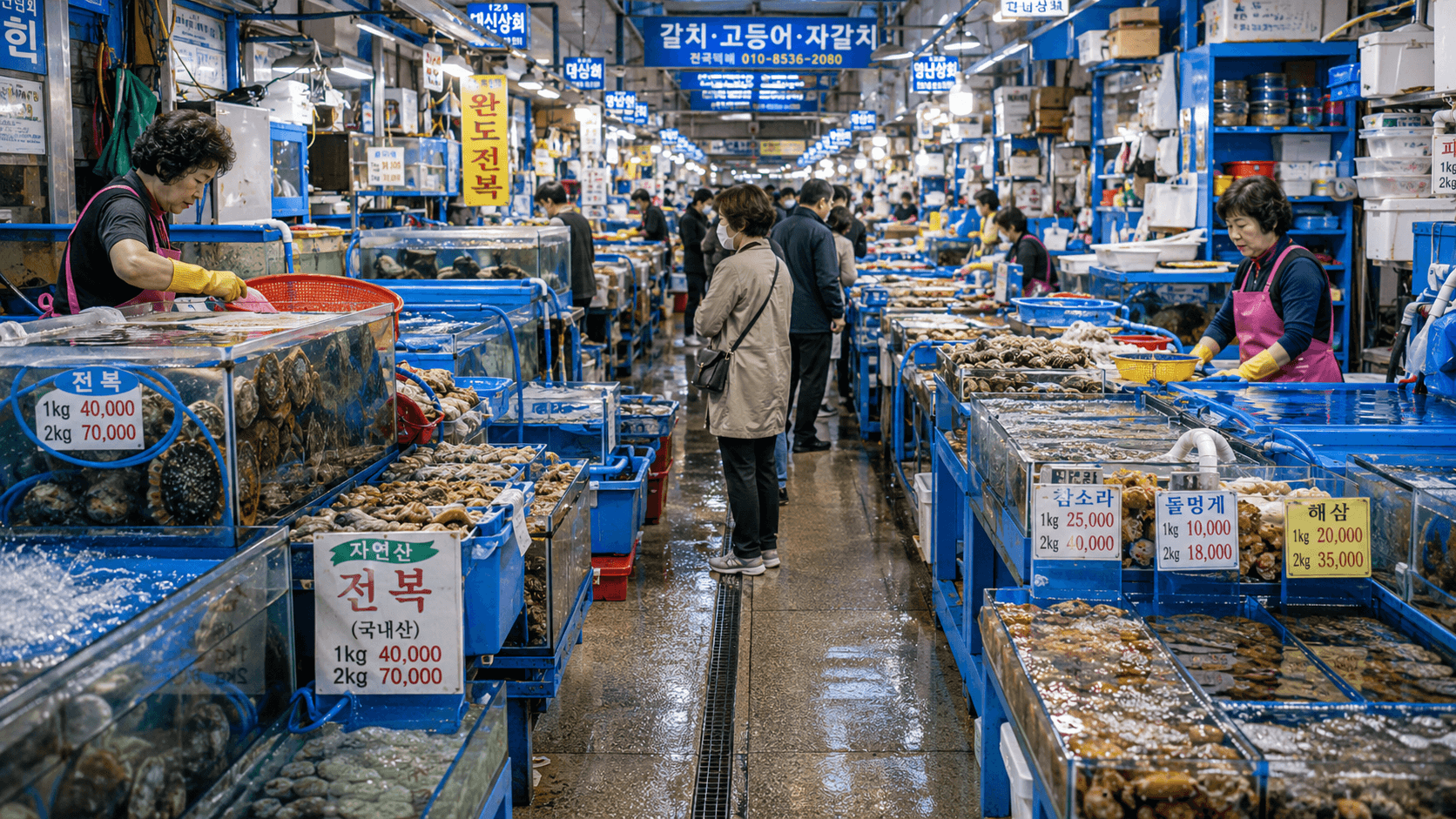
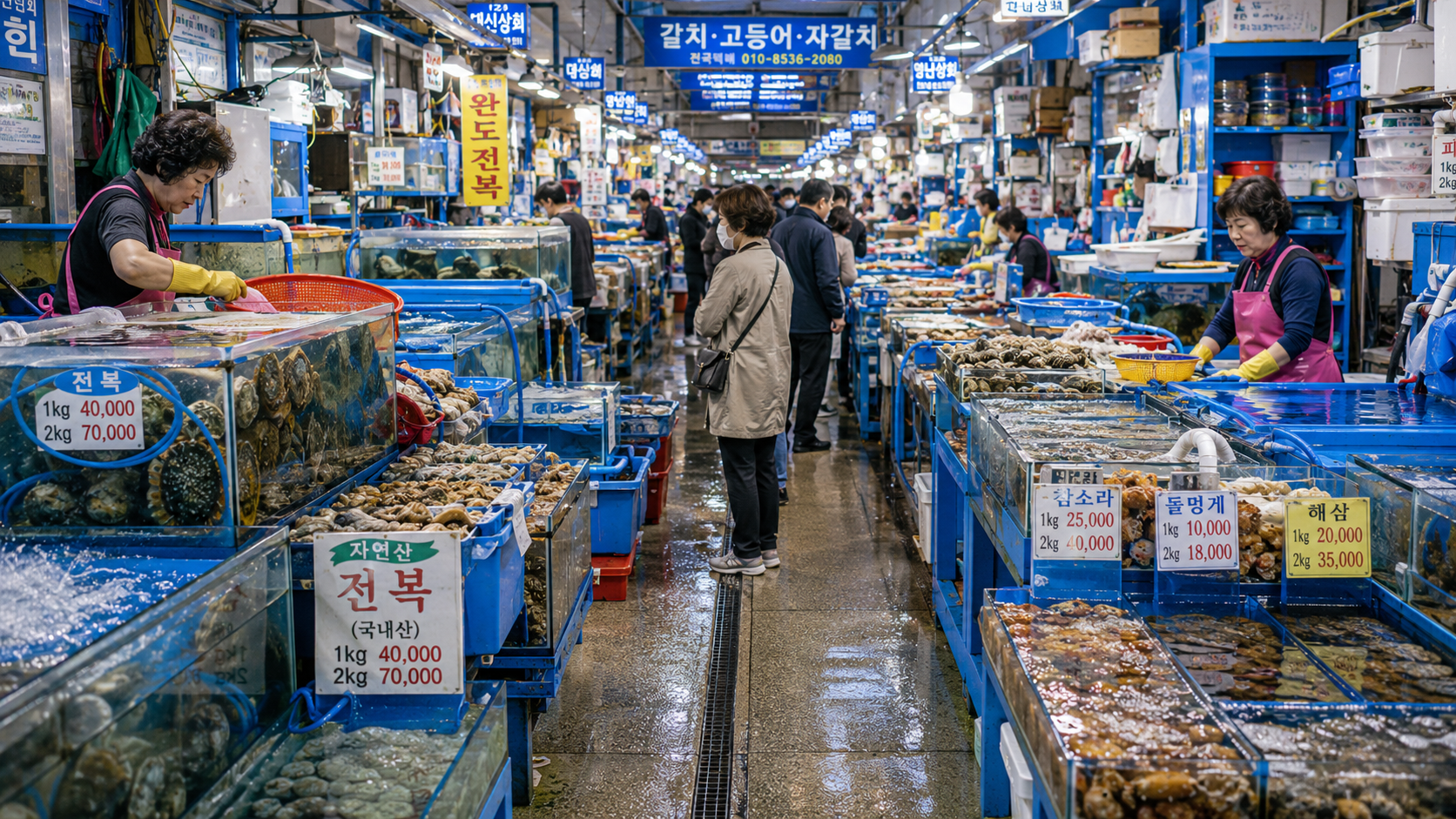
Jagalchi Market (자갈치시장) is a working seafood district centered on Busan’s waterfront. The modernized market building is at 52 Jagalchihaean-ro, Jung-gu. The Busan Infrastructure Corporation’s official Jagalchi website provides building, shop, facility, parking, and notice information; it listed the customer center as operating from 09:00 to 18:00 when checked on June 11, 2026. That customer-center schedule is not a guarantee that every seafood seller or restaurant follows the same hours.
At seafood markets, establish the full price before committing. Ask separately about:
- The seafood price by item or weight
- Preparation or cooking charges
- Table-setting charges
- Side dishes or additional portions
- Whether the quoted amount is the final total
A useful phrase is “Modu eolmayeyo?” (모두 얼마예요?), meaning “How much is everything?” You can also type the numbers into your phone calculator and ask the seller to confirm the total.
Seomun Market, Daegu: textiles and regional food
Seomun Market (서문시장) is associated particularly with textiles, sewing-related goods, and food stalls. Its name means “west gate market.” The market occupies multiple buildings and lanes, so operating patterns differ between retail shops, food businesses, and any separately scheduled night-market program.
Do not assume that a night market is running simply because older travel articles mention it. Seasonal programs, weekly schedules, and temporary suspensions can change. Check Daegu’s official tourism information or the market’s current notices on the day of your visit.
Jeju markets: check which one you mean
Jeju City has several traditional markets with similar-sounding names, so verify the Korean name and address before taking a taxi. Dongmun Traditional Market and Jeju Seomun Market are different places.
The official Visit Jeju listing for Jeju Seomun Market describes a permanent market specializing in meat and livestock products. When checked on June 11, 2026, it listed general hours of 09:00–20:00 while explicitly noting that schedules vary by store. Its dine-in arrangement may involve buying meat from a butcher and paying a separate table-setting fee at a restaurant; confirm the current fee before ordering.
How to eat at a market without confusion
1. Check the menu and price first
Look for a printed menu, price board, or labels beside the food. Some stalls specialize in one dish and may not have an English menu. Translation apps can help, but prices and portion sizes still need direct confirmation.
Use these phrases:
- Igeo eolmayeyo? (이거 얼마예요?) — How much is this?
- Hana juseyo (하나 주세요) — One, please.
- An maepge haejuseyo (안 맵게 해주세요) — Please make it not spicy. This may not be possible for food prepared in advance.
- Pojang haejuseyo (포장해 주세요) — Please pack it to go.
2. Confirm whether you sit first or order first
At counter stalls, customers generally order and then take an available seat. At small restaurants, a worker may direct you to a table before taking the order. Avoid occupying limited seats while one person in your group browses elsewhere.
3. Order a realistic amount
A stall may have a minimum order, particularly for shared dishes or seafood. Ask whether one portion is enough for your group. Ordering several full dishes at once can leave little room to try anything else.
4. Return dishes correctly
Some stalls collect bowls at the counter; others expect customers to leave them at the seat. Follow nearby customers or ask “Eodie dwayo?” (어디에 둬요?), meaning “Where do I put this?”
Payment, cash, and receipts
Korea has widespread card use, but a traditional market contains independent businesses with different payment systems. A permanent shop may accept cards while a temporary produce seller in the next lane takes only cash or domestic transfers.
For visitors, the practical approach is:
- Carry a physical international card and KRW cash.
- Keep ₩1,000, ₩5,000, and ₩10,000 notes for small purchases.
- Ask about card payment before food is prepared if cash is limited.
- Do not rely on foreign mobile wallets or overseas-issued contactless cards.
- Request a receipt for expensive goods, shipping, or any order collected later.
Onnuri gift certificates are a Korean traditional-market payment program, but purchase methods, app requirements, discounts, and accepted merchants can change. Short-term visitors should not rely on them as their only payment method unless they have confirmed current eligibility and registration requirements through the official service.
Bargaining and market etiquette
Bargaining is not a universal rule. Do not negotiate over a bowl of noodles, a clearly priced snack, or a small purchase simply because it is sold in a market.
For clothing, accessories, or several identical items, you can politely ask whether a discount is available: “Jogeum kkaeojul su isseoyo?” (조금 깎아줄 수 있어요?), meaning “Could you reduce it a little?” Accept the answer without pressure.
Always ask before photographing a vendor at close range. Photographing the overall aisle is usually less intrusive, but food preparation areas, customers, and faces still deserve consideration. Keep bags close to your body in narrow lanes and yield to handcarts and workers moving stock.
Dietary restrictions and food safety
Market food can contain ingredients that are not obvious from appearance. Broth may include anchovy, beef, pork, or shellfish; sauces commonly contain soy, wheat, sesame, garlic, and chili. Shared grills, knives, oil, and preparation surfaces make strict allergen separation unlikely at small stalls.
Show a clearly translated allergy card rather than relying only on spoken English. If cross-contact could cause a severe reaction, choose a business able to explain ingredients and preparation methods. This guide cannot replace medical advice; travelers with serious allergies should prepare an emergency plan with a qualified healthcare professional before travel.
For takeaway food, consider temperature and travel time. Raw seafood, raw beef, rice rolls, meat dishes, and dairy-based snacks should not remain unrefrigerated during a long day of sightseeing.
Accessibility, toilets, and luggage
Accessibility varies sharply. Modernized market buildings may have elevators, ramps, accessible toilets, and parking, while older lanes can have steps, slopes, narrow passages, wet surfaces, and crowded entrances. Official listings do not always describe every barrier.
Contact the market office or local tourist information center for route-specific information if step-free access is essential. Jagalchi’s official site, for example, maintains separate information for conveniences, rest areas, parking, and building facilities.
Large suitcases are difficult to manage and may obstruct working aisles. Leave luggage at your accommodation or a station locker. Public toilets are more likely near parking areas, subway stations, customer centers, or larger market buildings than beside small outdoor stalls.
Common mistakes to avoid
- Arriving at a five-day market on the wrong date
- Assuming every section follows the hours shown for the main market
- Ordering seafood without confirming weight and preparation charges
- Depending entirely on an international card or mobile wallet
- Treating bargaining as mandatory
- Photographing vendors at close range without permission
- Expecting every “night market” mentioned in an old article to be operating
- Bringing large luggage into crowded food lanes
- Buying fresh or raw food before several hours of sightseeing
What to check before you go
- Search the market’s Korean name and confirm the exact address.
- Check the official market, city, or tourism website for current notices.
- Verify the date if it is a five-day market.
- Confirm the relevant section’s hours, not only the market’s general hours.
- Check for holiday closures, summer breaks, construction, or seasonal night-market schedules.
- Bring KRW cash, a physical card, and a reusable bag.
- Save dietary restrictions in Korean on your phone.
- Leave large luggage elsewhere and check the weather for open-air sections.
- For a specific shop, save its building, floor, stall number, and telephone number.
Your next step is to choose a market based on one clear purpose—street food, seafood, textiles, household shopping, or a regional market day—and then verify that market’s current schedule through its official listing immediately before travel.