Seoul is a city where you can eat exceptionally well at almost any budget, but choosing from an unfamiliar Korean menu can be difficult. Start with a mix of experiences: one barbecue meal, one rice or soup meal, a market visit, and a casual snack-bar meal. This gives you a broader picture of Korean food than trying to visit only famous restaurants.
This guide was checked on June 11, 2026. Restaurant prices, opening hours, reservation policies, and branch information change frequently, so confirm them directly before making a special journey.
At a glance
| If you want... | Order... | Korean name |
|---|---|---|
| A first Korean barbecue meal | Grilled pork belly | Samgyeopsal (삼겹살) |
| A mild, filling rice dish | Mixed rice with vegetables | Bibimbap (비빔밥) |
| A warming soup | Ox-bone soup | Seolleongtang (설렁탕) |
| A spicy comfort meal | Kimchi stew | Kimchi jjigae (김치찌개) |
| Market food | Mung-bean pancake | Bindaetteok (빈대떡) |
| A quick snack | Rice rolls and spicy rice cakes | Gimbap (김밥) and tteokbokki (떡볶이) |
| A vegetarian-focused meal | Korean Buddhist temple food | Sachal eumsik (사찰음식) |
| A cold summer dish | Chilled buckwheat noodles | Naengmyeon (냉면) |
Essential Seoul meals
Korean barbecue: samgyeopsal or galbi
For a straightforward first barbecue meal, order samgyeopsal, thick slices of pork belly cooked on a tabletop grill. The meat is normally eaten with lettuce, sliced garlic, sauces, kimchi, and other small side dishes called banchan (반찬).
Galbi (갈비) means ribs. Beef galbi is generally more expensive than pork, while dwaeji galbi (돼지갈비) is marinated pork rib meat with a sweet-savory flavor. Another useful order is mok-sal (목살), pork neck or shoulder, which is leaner than pork belly.
Barbecue portions are priced per serving, and some restaurants require at least two initial servings. A serving may not equal a complete Western-style main course, so check the weight and minimum order on the menu. Rice, stew, noodles, and alcohol are usually separate.
Staff may cook the meat for you, cook only the first batch, or leave the grill entirely to your table. Follow their lead. Use the provided tongs and scissors for raw or cooking meat rather than your personal chopsticks.
Bibimbap: the easiest all-in-one meal
Bibimbap combines rice, seasoned vegetables, and frequently meat and egg. Add the red gochujang chili paste gradually, then mix everything thoroughly.
The hot-stone version, dolsot bibimbap (돌솥비빔밥), continues cooking at the table and produces a crisp layer of rice at the bottom. Let the bowl sit briefly before mixing if you want more crust, but be careful: the stone remains extremely hot.
Bibimbap is useful for solo diners and first-time visitors because it is a complete individual meal. However, it is not automatically vegetarian. Meat, egg, fish-based seasoning, or anchovy stock may be included.
Seolleongtang and gomtang: mild beef soups
Seolleongtang is a cloudy soup made by simmering beef bones and other beef parts. It usually arrives lightly seasoned, with salt and chopped spring onion available at the table. Add a small amount, taste, and adjust.
Gomtang (곰탕) is another family of long-simmered beef soups. Its broth is often clearer, although recipes differ by restaurant. Both are good choices when you want something mild, warming, and less sweet or spicy than many better-known Korean dishes.
Rice may arrive separately or already in the soup. Kimchi and kkakdugi (깍두기), cubed radish kimchi, provide acidity and heat.
Kimchi jjigae and doenjang jjigae: everyday stews
Kimchi jjigae is a bubbling stew commonly made with aged kimchi, tofu, pork, tuna, or another protein. It can be moderately to very spicy and is normally eaten with rice.
Doenjang jjigae (된장찌개) is based on fermented soybean paste. It has a deep, salty flavor and commonly contains tofu and vegetables. It may also contain clams, meat, or anchovy stock, so neither stew should be assumed to be vegetarian.
At barbecue restaurants, a small stew is often ordered toward the end of the meal. At neighborhood restaurants, a larger stew may be sold for two or more diners.
Naengmyeon: cold noodles with a strong following
Naengmyeon consists of thin, chewy noodles served cold. The two principal versions are:
- Mul naengmyeon (물냉면): noodles in a chilled broth, sometimes with ice
- Bibim naengmyeon (비빔냉면): noodles mixed with a spicy red sauce
The noodles can be unusually long and firm. Scissors may be provided, although diners differ on whether they use them. Mustard and vinegar are often available for adjusting the flavor.
Naengmyeon is particularly refreshing in hot weather, but it is also eaten after grilled meat. The broth may be beef-based, and bibim sauce can contain ingredients that are not obvious from an English description.
Kalguksu and mandu: noodles and dumplings
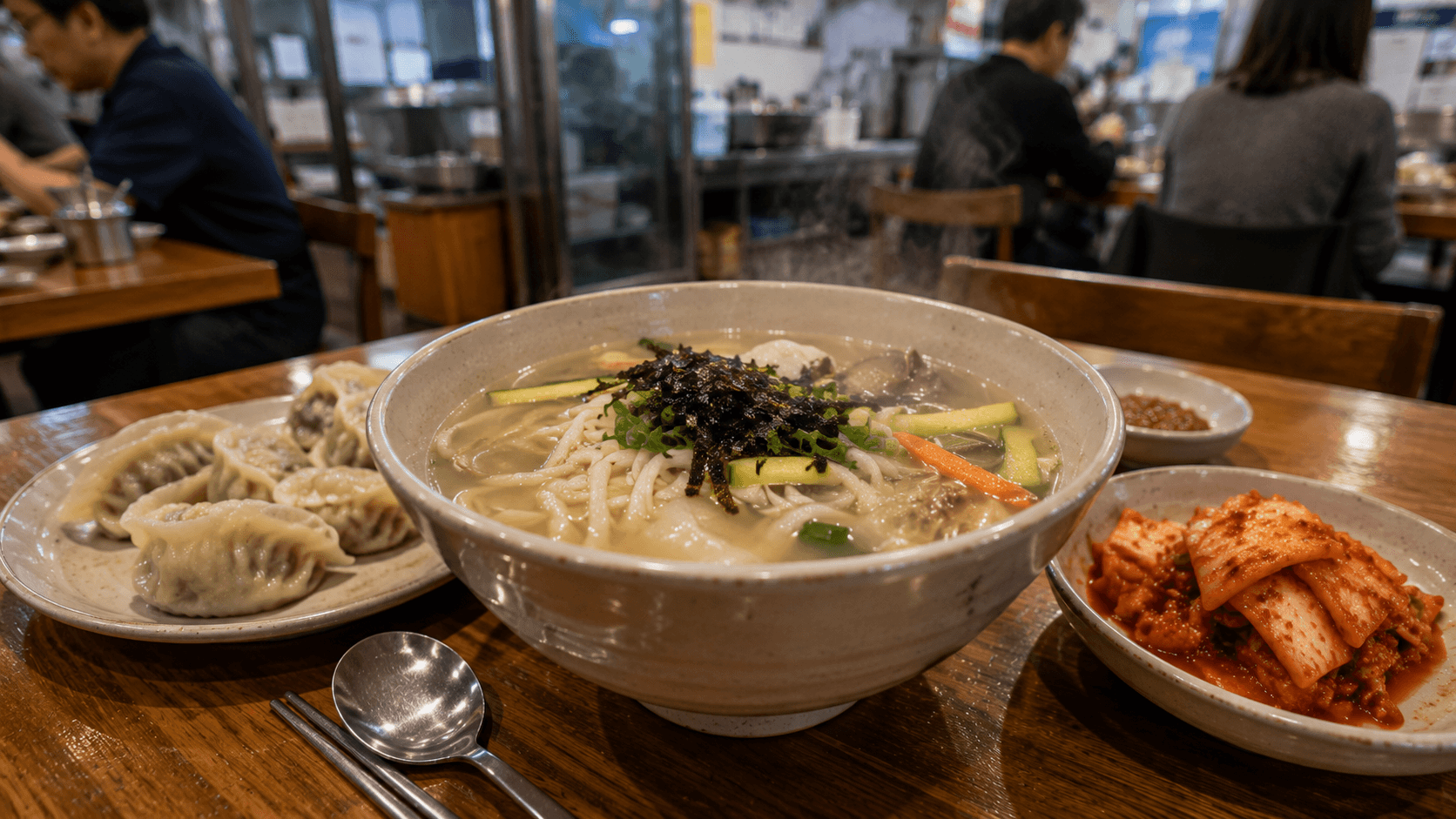
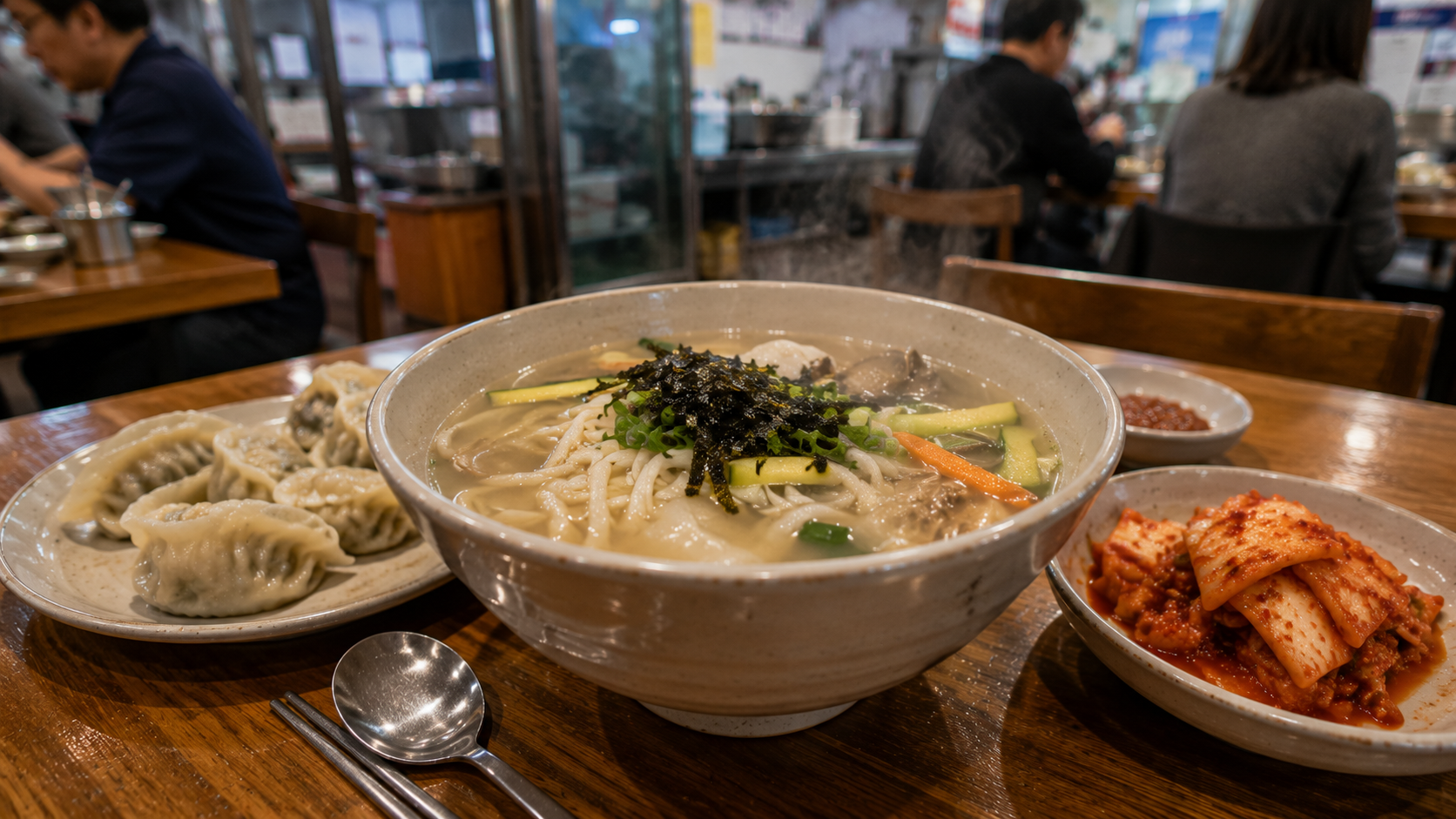
Kalguksu (칼국수) means knife-cut noodles. The broad wheat noodles are served in broth, with versions based on chicken, seafood, anchovies, clams, or vegetables. It is filling without being excessively heavy.
Pair it with mandu (만두), Korean dumplings that may be steamed, boiled, or fried. Common fillings include pork, tofu, vegetables, glass noodles, and kimchi. A dumpling described as “vegetable” may still contain meat or meat seasoning, so ask if this matters to you.
Street food and casual snacks
Tteokbokki, gimbap, and eomuk
A bunsikjip (분식집) is a casual Korean snack restaurant. It is one of the easiest places to try several inexpensive dishes without arranging a full meal.
Order tteokbokki, chewy cylindrical rice cakes in a sweet-spicy red sauce. Standard versions commonly contain eomuk (어묵), processed fish cake. If you are sensitive to chili heat, do not assume that the sweetness makes the dish mild.
Gimbap is rice and fillings rolled in dried seaweed. It resembles sushi visually but uses different seasoning and fillings. Common varieties contain egg, pickled radish, vegetables, ham, tuna, beef, or cheese. It is portable and convenient for train journeys, picnics, and quick lunches.
Eomuk is also sold on skewers in hot broth. Ask before drinking the broth if you have fish, shellfish, soy, or wheat restrictions.
Bindaetteok and market pancakes
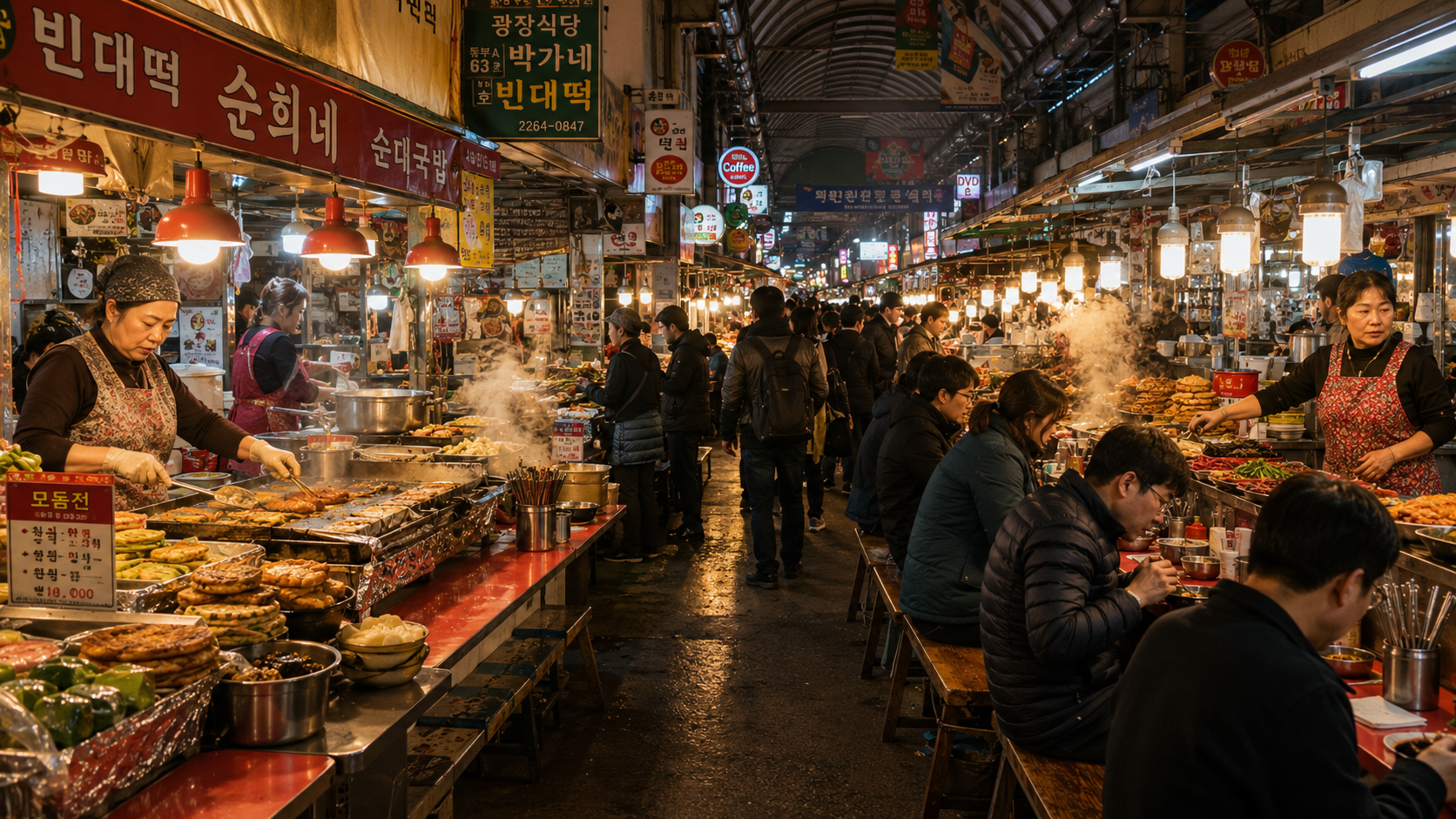
Bindaetteok is a substantial savory pancake made from ground mung beans, often with vegetables, kimchi, or pork. It is strongly associated with Gwangjang Market, where it is cooked on large griddles and usually served with a soy-and-onion dipping sauce.
One pancake can be heavy and oily, so sharing leaves room for other foods. Other useful market orders include small gimbap rolls, dumplings, noodles, and yukhoe (육회), seasoned raw beef. Raw meat carries additional food-safety risk; people who are pregnant, immunocompromised, elderly, or otherwise medically vulnerable should seek professional medical guidance and choose cooked alternatives.
Hotteok: a hot, filled pancake
Hotteok (호떡) is a griddled pancake usually filled with molten brown sugar, cinnamon, seeds, or nuts. Savory versions also exist. Eat it carefully because the filling can remain much hotter than the outside suggests.
Hotteok is more widely available in cool weather, although permanent market stalls may sell it throughout the year.
Where to explore food in Seoul
Gwangjang Market
Gwangjang Market is a practical stop for bindaetteok, small gimbap rolls, noodles, dumplings, and raw-beef dishes. It is busy, compact, and easy to combine with Jongno, Cheonggyecheon Stream, or Dongdaemun.
Go with one or two companions if possible so you can share. Ask the price before ordering when it is not clearly displayed, and do not assume every vendor accepts foreign cards. Market stalls have independent schedules and may close without notice.
Namdaemun Market
Namdaemun is particularly useful for sit-down food alleys as well as snacks. Its specialties include galchi jorim (갈치조림), cutlassfish braised in a spicy sauce, and kalguksu. The market’s official website lists food areas, specialized alleys, directions, and merchant information, but each business sets its own hours. Check the official Namdaemun Market website before visiting.
Mangwon Market
Mangwon Market is a neighborhood market with prepared foods, fried snacks, side dishes, fruit, and takeaway options. It pairs well with a visit to Mangwon-dong or the nearby Hangang parks. Buy modest portions first: takeaway foods accumulate quickly, and seating may be limited.
Jongno, Euljiro, and Mapo
Jongno and Euljiro are useful for old-style soup restaurants, grilled fish, barbecue, pancakes, and after-work drinking food. Mapo is strongly associated with barbecue and beef soups. Rather than crossing Seoul for one social-media-famous shop, look for a focused menu, visible prices, and a steady flow of local customers.
Vegetarian, vegan, halal, and allergy-aware dining
Dietary communication requires care in Korea because ingredients such as anchovy broth, fish sauce, shrimp paste, meat stock, egg, and oyster sauce may not appear in an English dish name.
Korean Buddhist temple food is the clearest traditional plant-based option. It normally avoids meat and seafood and also excludes the five pungent vegetables used in many Buddhist traditions, including garlic and spring onion. Confirm the individual restaurant’s policy rather than assuming that every restaurant using the word “temple” follows the same rules.
For halal food, distinguish between certified halal restaurants, Muslim-owned restaurants, pork-free menus, and places merely described as Muslim-friendly. These labels are not interchangeable. Use the Korea Tourism Organization’s VISITKOREA website and navigate to Things to Do → Muslim-friendly Travel for its current listings and explanations.
If you have a serious allergy, carry a Korean-language allergy card listing the exact ingredients, cross-contact risk, and required response. Showing only the English word “allergy” may not communicate the severity. Seoul’s official Food Safety Information portal provides municipal food-safety information, although much of the material is in Korean. Seek medical advice for managing severe allergies while traveling.
How ordering and payment work
Menus may be on paper, on a wall, at a touchscreen kiosk, or accessed through a QR code. Some restaurants require each diner to order one main item, while barbecue and hot-pot restaurants may impose minimum portions.
Water and banchan are frequently included, but refills and policies vary. Self-service stations are common. Cutlery and napkins may be in a drawer under the table rather than placed on top.
At many casual restaurants, you pay at the counter when leaving. Cards are widely used in Seoul, but foreign cards occasionally fail, and small market vendors may prefer cash or account transfer. Carry some KRW rather than relying on a single card or mobile wallet.
Solo dining is straightforward at noodle shops, soup restaurants, food courts, convenience stores, and gimbap shops. It can be harder at barbecue, hot-pot, and large shared-dish restaurants because of minimum orders.
Useful Korean phrases
- Igeo hana juseyo (이거 하나 주세요): One of these, please.
- An maepge hae juseyo (안 맵게 해 주세요): Please make it not spicy. This may not be possible for a premade sauce.
- Gogi eopseoyo? (고기 없어요?): Is there no meat?
- Yuksu-e gogi deureogayo? (육수에 고기 들어가요?): Does the broth contain meat?
- Saengseonina jeotgal deureogayo? (생선이나 젓갈 들어가요?): Does it contain fish or salted seafood?
- Igeo eolmayeyo? (이거 얼마예요?): How much is this?
- Pojang hae juseyo (포장해 주세요): Please pack it to go.
- Gyesanhalgeyo (계산할게요): I would like to pay.
Translation apps help, but show the full ingredient question in Korean rather than relying on a single translated word.
Common mistakes to avoid
- Ordering several full dishes before checking portion sizes
- Assuming every red dish is extremely spicy, or that every pale dish is mild
- Assuming kimchi, vegetable dumplings, or tofu stew is vegetarian
- Ordering raw beef or raw seafood without considering personal health risks
- Traveling across the city without checking the restaurant’s latest break time or closing day
- Expecting every barbecue restaurant to serve one person
- Putting chopsticks vertically into a bowl of rice
- Using raw-meat tongs to eat cooked meat
What to check before you go
- Confirm the latest opening hours and afternoon break time on the restaurant’s official channel.
- Check whether reservations are accepted or required.
- Look for minimum orders, especially for barbecue and shared dishes.
- Save the restaurant’s Korean name and address for navigation.
- Carry a physical payment card and some KRW for markets or card failures.
- Prepare written Korean explanations for allergies or religious restrictions.
- Check whether the venue has stairs, floor seating, narrow aisles, or accessible toilets if mobility is a concern.
- For immediate visitor assistance, use the 1330 Korea Travel Helpline linked from the official VISITKOREA homepage. Its current contact options should be confirmed there before use.
A sensible next step is to choose one market near your sightseeing route and reserve one barbecue or specialty dinner. Leave the remaining meals flexible: neighborhood soup, noodle, and gimbap restaurants are often the easiest way to discover what you genuinely enjoy.