Korean snacks are available almost everywhere in South Korea, but the right place depends on what you want. Convenience stores are easiest for small portions and limited-edition products. Large supermarkets usually offer the widest selection and better value for bulk purchases. Traditional markets are useful for freshly made treats, while department-store food halls specialize in polished gifts.
Store details, services, and shopping conditions in this guide were checked on June 11, 2026. Product availability, promotions, opening hours, and regular closing days vary by branch, so confirm them with the individual store before making a special trip.
Quick answer
| Where to shop | Best for | Main limitation |
|---|---|---|
| Convenience stores | Small packs, drinks, new products, late shopping | Higher unit prices and limited stock |
| Large supermarkets | Variety, multipacks, family-size bags, comparison shopping | Branch-specific holidays and large packages |
| Neighborhood supermarkets | Everyday snacks near your accommodation | Less English information and a smaller range |
| Traditional markets | Fresh rice cakes, traditional sweets, regional foods | Short shelf life and variable payment options |
| Department-store food halls | Premium gifts and attractive packaging | Higher prices |
| Brand stores and specialty shops | Specific products or unusual flavors | Not available in every city |
| Airport shops | Last-minute purchases | Smaller selection and usually poor value |
For most travelers, the simplest strategy is to sample individual snacks at convenience stores during the trip, then visit a large supermarket one or two days before departure for multipacks and gifts.
Convenience stores: easiest for trying one of everything
Korea's major convenience-store chains include CU, GS25, 7-Eleven, and Emart24. They are common around subway stations, university areas, residential neighborhoods, and transport terminals. The official CU website provides an English introduction to the chain and its services.
Convenience stores are particularly useful for:
- Small bags of chips, crackers, gummies, and chocolate
- Seasonal or convenience-store-exclusive products
- Single bottles or cartons of Korean drinks
- Packaged bread, ice cream, and refrigerated desserts
- Small portions that you can taste before buying a multipack elsewhere
- Instant noodles, including cup versions that can be prepared in the store
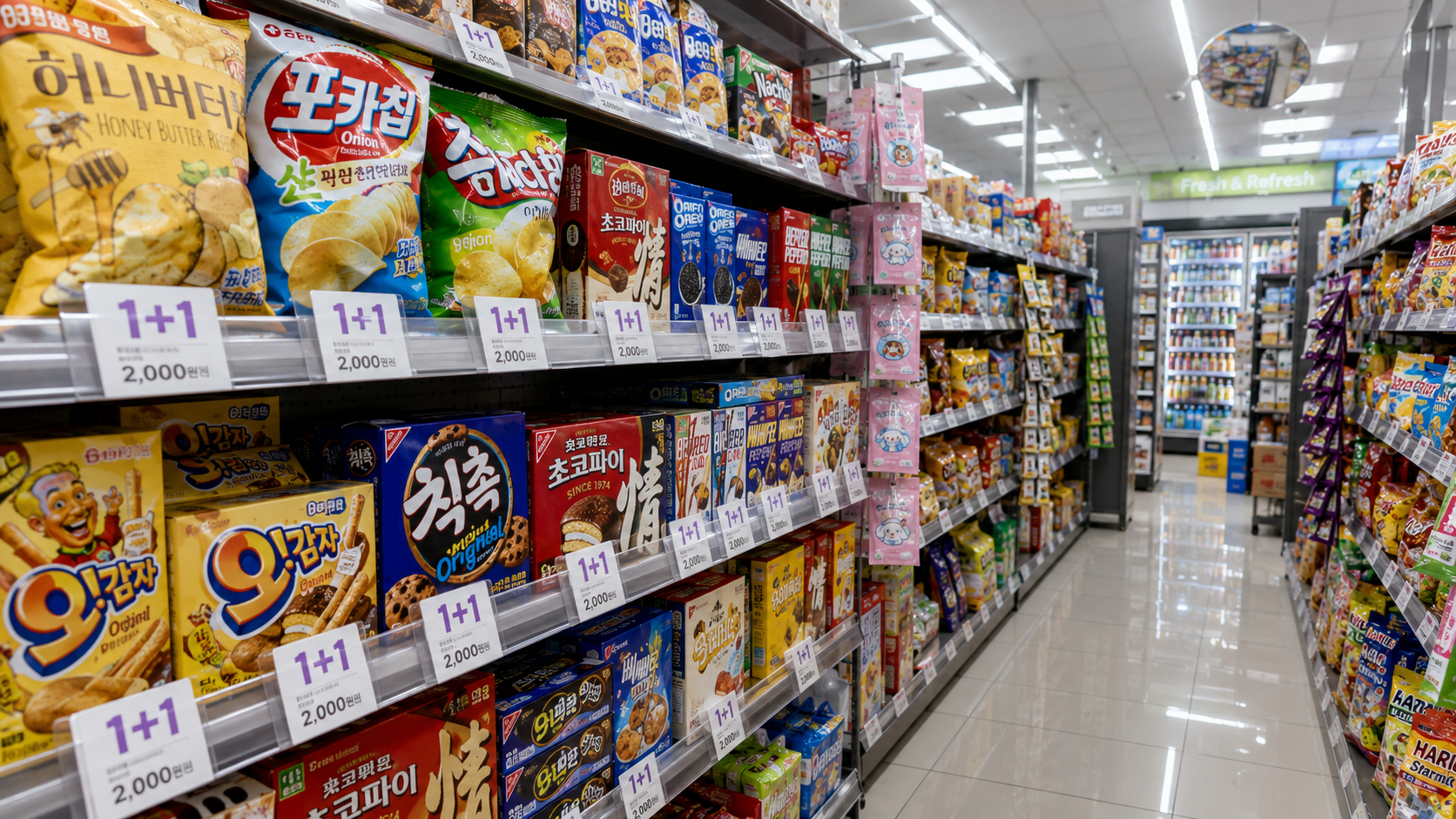
Look for promotion labels such as 1+1, meaning buy one and receive one additional item, or 2+1, meaning buy two and receive a third. These offers apply only to marked products and can change frequently. Check whether the cashier has scanned every promotional item before paying.
Do not assume that every branch carries the same products. A small store inside a subway station may focus on drinks and quick meals, while a larger residential branch may have several aisles of snacks. Stores near universities often carry more inexpensive, trend-driven products.
Cards are widely used in Korean chain stores, but a foreign-issued card can occasionally be declined because of the card network or terminal settings. Carry a second card and a modest amount of KRW as backup.
What to look for
Useful Korean words on shelves include:
- 과자 (gwaja): snacks, usually chips, crackers, or cookies
- 사탕 (satang): candy
- 젤리 (jelli): gummy candy or jelly sweets
- 초콜릿 (chokollit): chocolate
- 한과 (hangwa): traditional Korean confectionery
- 약과 (yakgwa): fried honey-and-ginger wheat pastry
- 떡 (tteok): rice cake
- 김 (gim): dried seaweed
- 매운맛 (maeunmat): spicy flavor
- 무설탕 (museoltang): no sugar or sugar-free, depending on the label context
Large supermarkets: best for range and multipacks
Large discount supermarkets, often called daehyeong mateu (대형마트), are the practical choice when you know what you want. Major operators include Emart, Lotte Mart, and Homeplus. They normally carry national brands, supermarket private-label products, multipacks, boxed gifts, dried foods, seaweed, tea, and ingredients that smaller stores may not stock.
A large supermarket is useful when you need:
- Individually wrapped snacks for coworkers or classmates
- Several flavors of the same product
- Large bags or multipacks
- Boxed seaweed, tea, or traditional sweets
- Ingredient and nutrition labels that are easier to examine
- Sturdy packages that can survive checked luggage
Selection differs significantly by branch. A full hypermarket usually has more choice than a compact supermarket carrying the same brand name. Search the store name in Naver Map or KakaoMap and check recent branch information rather than relying only on an international map service.
Large retailers can have branch-specific regular holidays. Opening hours may also change on public holidays, during Seollal, the Korean Lunar New Year, and during Chuseok. No nationwide opening schedule could be reliably applied to every supermarket as of June 11, 2026, so verify the individual branch on the day you plan to visit.
Convenient supermarket locations in Seoul
Travelers often look for supermarkets near major transport or shopping districts. Instead of assuming that a well-known branch is still operating under an old name or schedule, use the retailer's current store information. Lotte's official English site lists its properties in areas including Myeong-dong, Jamsil, Gimpo Airport, and Seoul Station; see the Lotte Shopping store information.
Outside Seoul, major supermarkets can be found in cities such as Busan, Daegu, Daejeon, Gwangju, Jeonju, Suwon, and Jeju City. A supermarket near your accommodation is usually more useful than carrying bulky bags across the city.
How to shop efficiently
- Photograph snacks you enjoy during the first part of your trip.
- Visit a large supermarket near the end of your stay.
- Compare the price per gram rather than only the package price.
- Check the expiration or best-before date before buying several boxes.
- Choose individually wrapped products if they will be shared.
- Place crushable chips in a rigid section of your suitcase or buy them last.
A practical snack-shopping budget is KRW 10,000 to KRW 30,000 per person, depending on quantity and packaging. This is a planning suggestion, not a fixed market-price estimate.
Neighborhood supermarkets: convenient and less overwhelming
Smaller local supermarkets are marked with names such as 마트 (mart) or 슈퍼 (syupeo, from supermarket). They serve nearby residents and often carry familiar Korean brands without the crowds or long aisles of a hypermarket.
These shops are good for ordinary cookies, crackers, instant noodles, dried seaweed, candy, and drinks. They may also have locally preferred products that are less prominent in tourist districts.
The trade-off is that English signage can be limited, and promotion rules may not be obvious. Card acceptance depends on the business, so keep cash available. If you want a bag, point to it or ask bongtu juseyo (봉투 주세요), meaning please give me a bag. Stores may charge for disposable bags.
Traditional markets: fresh and regional snacks
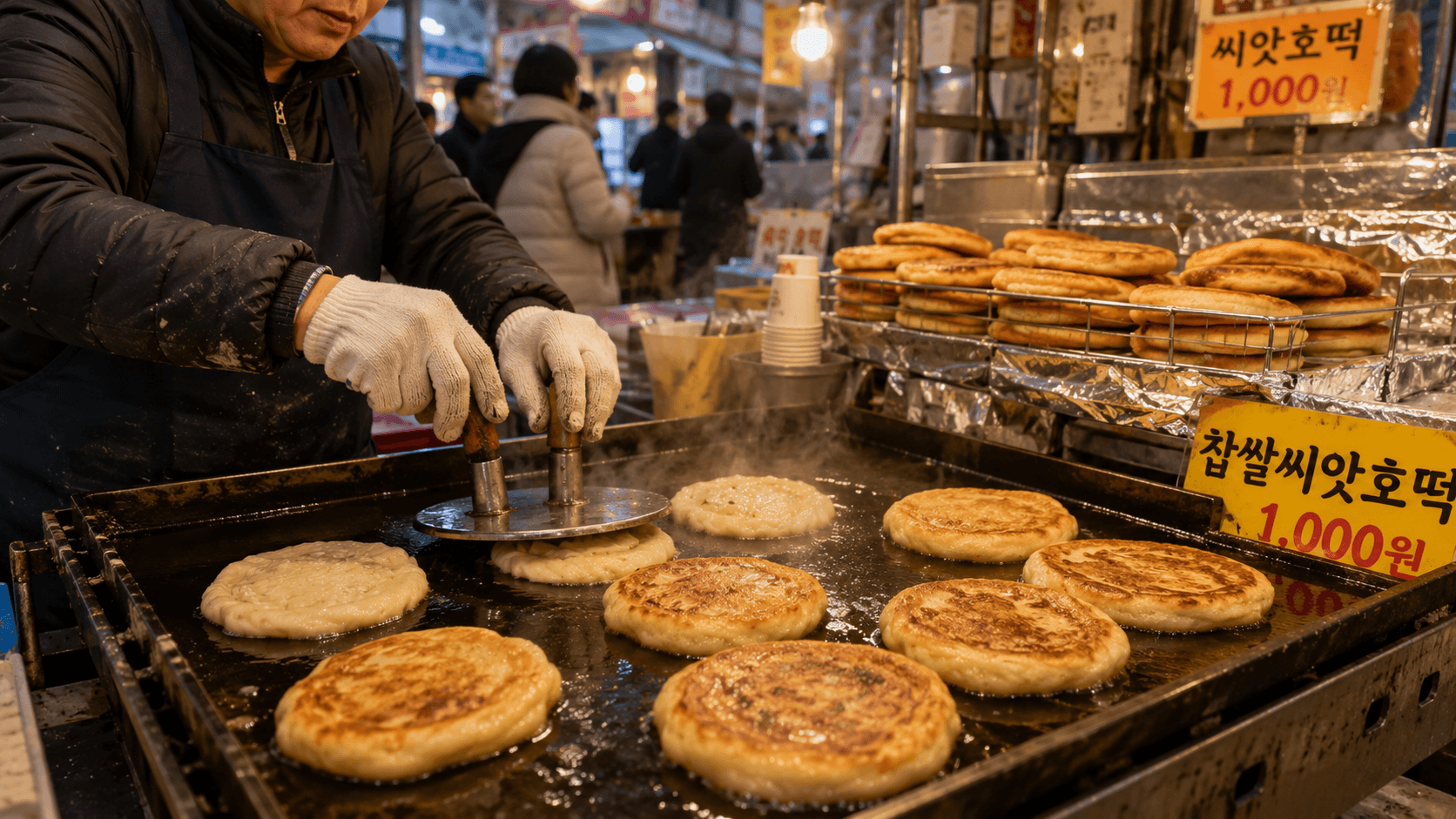
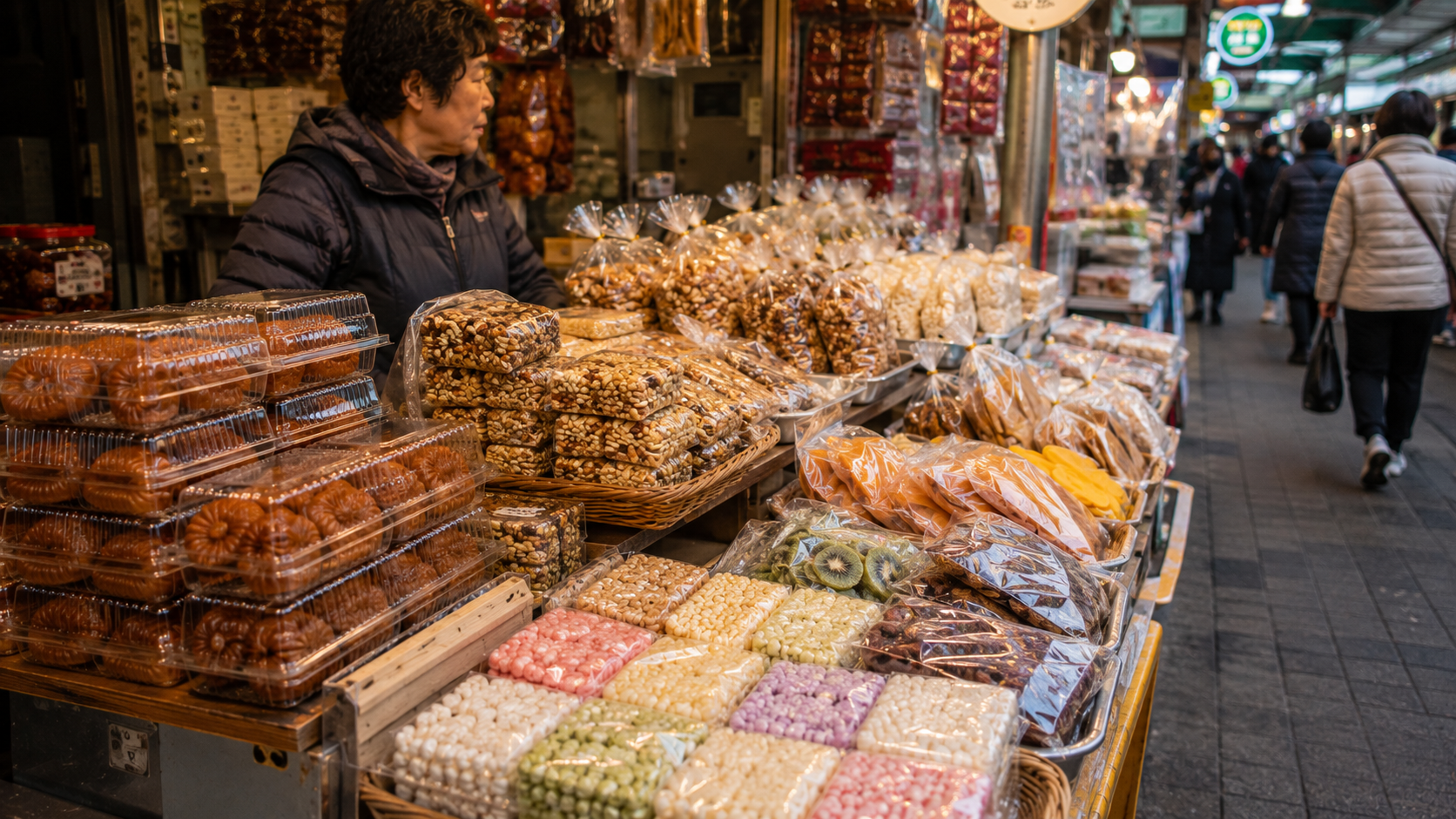
Traditional markets are better for foods that feel connected to a neighborhood or region than for mass-produced chips. Common purchases include rice cakes, yakgwa, gangjeong puffed-rice sweets, dried fruit, roasted nuts, seaweed, grain snacks, and locally made confectionery.
In Seoul, Gwangjang Market (광장시장) has food stalls and vendors selling packaged and fresh foods; practical visitor information is available from the official Gwangjang Market website. Namdaemun Market (남대문시장) also contains food shops among its many specialized shopping areas; consult the official Namdaemun Market website before visiting.
Markets are also worthwhile outside Seoul. Look for a city's jungang sijang (중앙시장), meaning central market, or ask a local tourism office about regional specialties.
Traditional markets require more judgment than supermarkets:
- Fresh rice cakes can become hard quickly and are not ideal for a long journey.
- Handmade products may not have English ingredient or allergen labels.
- Different stalls may quote different prices or package sizes.
- Some vendors accept cards, while others prefer cash or domestic bank transfers.
- Opening times belong to individual vendors, even inside the same market.
Ask the price before ordering unpackaged food. The phrase igeo eolmayeyo? (이거 얼마예요?) means how much is this? For gifts, choose sealed products displaying the manufacturer, ingredients, net weight, and date information.
Department-store food halls: best for formal gifts
Department stores generally place their food halls on a basement floor, commonly labeled B1. This is where to look for premium hangwa, fruit preserves, tea, seaweed, rice crackers, bakery products, and gift sets.
Food halls cost more than supermarkets, but they offer several advantages:
- More polished packaging
- Staff-assisted gift selection
- Strong boxes that travel well
- Premium or regional brands gathered in one place
- Refrigerated storage until purchase
Lotte's official English shopping site confirms facilities such as storage, interpretation, payment information, and tax-refund guidance at participating properties. Services differ by branch, so consult the official store pages rather than assuming that every location provides them.
Food halls are most suitable when presentation matters. For casual office sharing, supermarket multipacks are usually more economical.
Specialty shops and brand stores
Some confectionery companies, bakeries, tea brands, and regional producers operate their own stores or temporary pop-ups. These can be useful for unusual flavors, collaboration packaging, or gift boxes unavailable in ordinary supermarkets.
Pop-ups are temporary by definition, so social-media posts and old travel articles become outdated quickly. Check the brand's official Korean website or verified social account on the day of your visit. Shopping complexes such as department stores may also list current pop-ups in their event pages.
For residents ordering online, Korean shopping platforms can offer larger quantities and more specialized products. However, account registration, Korean delivery addresses, identity verification, and payment requirements vary. New visitors will generally find in-person shopping simpler.
Should you wait until the airport?
Airport shopping is useful only as a backup. Convenience stores and duty-free areas may sell recognizable Korean snacks, seaweed, and gift boxes, but they cannot match the range of a city supermarket. Airport inventory, terminal locations, and operating hours can change, so check the Incheon International Airport website before relying on a particular shop.
Buy fragile or bulky snacks in the city and pack them before leaving your hotel. Use airport stores for forgotten gifts, a final drink, or something to eat during the journey.
Checking ingredients and dietary needs
Korean packaged foods normally provide detailed information in Korean, but an English translation is not guaranteed. Common allergens can appear in unexpected products, including milk in chips, shellfish flavoring in crackers, or wheat and soy in sauces.
Use a translation app's camera function, but do not treat automated translation as definitive when an allergy is serious. Ask the manufacturer or avoid the product if the label is unclear. Korea's Ministry of Food and Drug Safety is the relevant national authority for food-safety and labeling information.
Vegetarian, vegan, halal, gluten-free, and nut-free claims should be checked product by product. A front label showing vegetables or the word vegetable does not establish that the seasoning contains no meat, seafood, dairy, or animal-derived ingredients.
Packing snacks for an international flight
Dry, factory-sealed snacks are generally the simplest items to transport, but admission into another country is controlled by that country's customs and agricultural authorities. Rules may restrict meat, dairy, eggs, fresh fruit, seeds, or products containing those ingredients.
Before purchasing large quantities:
- Check the customs website for your destination and any transit country.
- Keep products in their original sealed packaging.
- Retain ingredient labels until after customs clearance.
- Declare food when the arrival form or officer requires it.
- Avoid assuming that a commercially packaged product is automatically permitted.
Korea Customs Service provides information for travelers leaving and entering Korea, but it does not determine what another country will admit. See the Korea Customs Service traveler guidance, then check your destination's authority separately.
Place liquids, gels, syrups, jams, and spreadable foods in checked baggage unless they comply with the security rules for your departure airport. Confirm current cabin-baggage limits with your airline and airport.
Common mistakes
- Buying everything at the first convenience store: Sample first, then buy larger packages at a supermarket.
- Trusting an old opening-hours post: Supermarket holidays and market-vendor hours change.
- Buying fresh rice cakes too early: Their texture deteriorates faster than packaged cookies or crackers.
- Ignoring suitcase volume: Chips and gift boxes occupy more space than their weight suggests.
- Assuming every flavor is available nationwide: Limited editions and private-label products can be chain- or branch-specific.
- Leaving all shopping until the airport: Selection is smaller and you have less time to compare labels.
- Relying on package pictures for dietary information: Read the ingredient and allergen statements.
What to check before you go
- Confirm the branch's opening hours and regular holiday.
- Check whether the store is a full supermarket or a smaller-format branch.
- Bring a backup payment method.
- Measure the empty space in your luggage.
- Review ingredient and allergen information.
- Check your destination's food-import restrictions.
- Buy refrigerated or fresh products only if you can store and transport them safely.
- Keep fragile packages away from shoes, bottles, and suitcase edges.
Your practical next step is to save one large supermarket near your final accommodation in Naver Map or KakaoMap. Use convenience stores for tasting during the trip, then complete your main snack purchase shortly before departure.