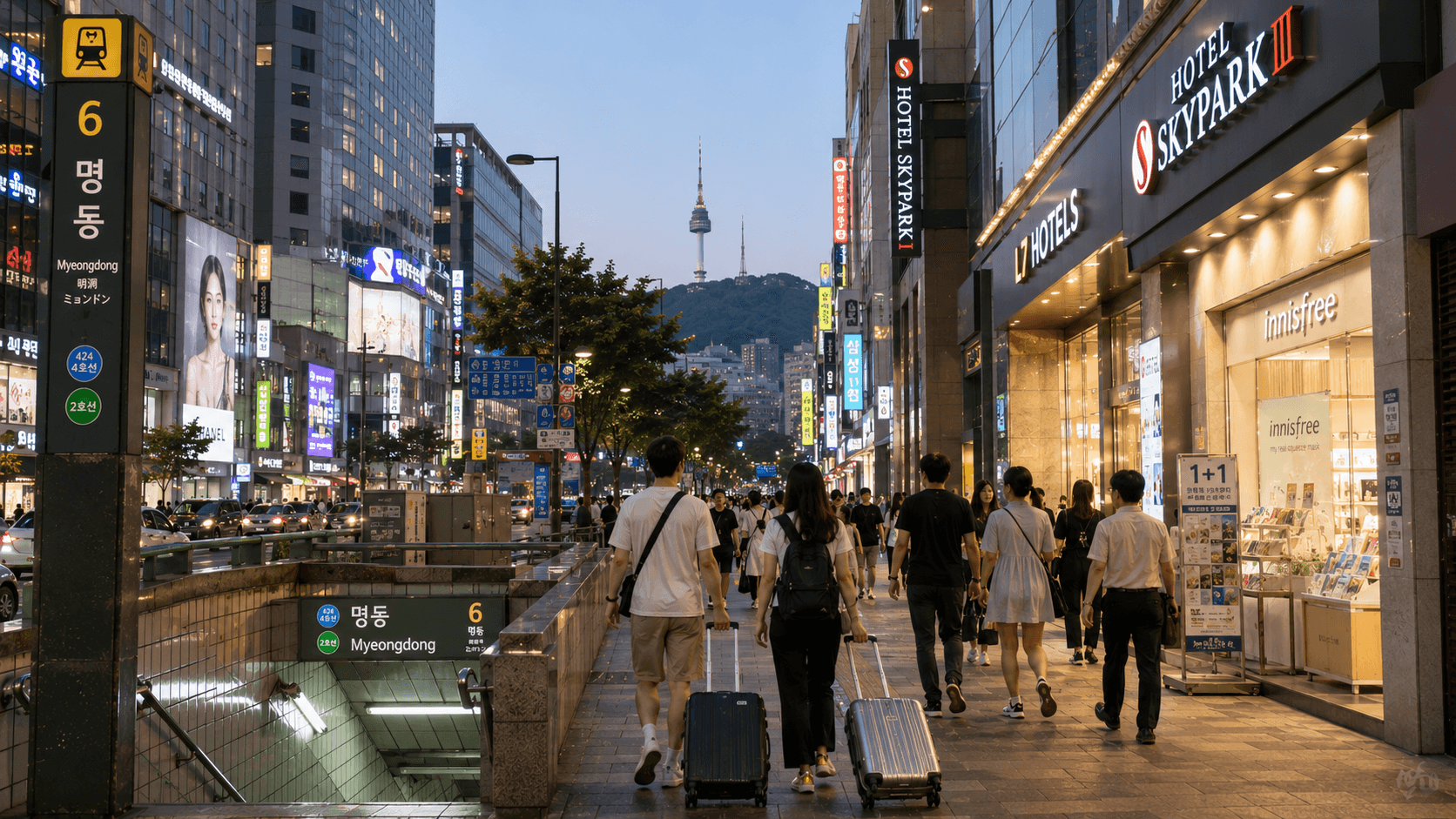
For most first-time visitors, Myeongdong or nearby Euljiro is the most practical place to stay in Seoul. This central area offers straightforward subway access, plenty of hotels and restaurants, and relatively short journeys to the palaces, traditional neighborhoods, major markets, and Seoul Station.
Myeongdong is not the right choice for everyone, however. Choose Jongno or Insadong for historic Seoul, Hongdae for nightlife and convenient airport rail access, Seoul Station for intercity trains, or Gangnam when most of your plans are south of the Han River.
Transport and visitor-service information in this guide was verified on June 11, 2026. Hotel prices change constantly, so use the neighborhood comparisons rather than fixed nightly-rate estimates.
At a glance
| Area | Most suitable for | Main advantage | Main drawback |
|---|---|---|---|
| Myeongdong and Euljiro | Most first-time visitors | Central and easy to navigate | Busy and strongly visitor-oriented |
| Jongno and Insadong | Palaces, history, quieter evenings | Walkable access to historic sights | Nightlife is more limited on some streets |
| Hongdae | Nightlife, cafés, younger travelers | Direct all-stop airport rail connection | Noise and weekend crowds |
| Seoul Station | Rail trips and airport transfers | AREX and major intercity trains | Immediate station area is less atmospheric |
| Gangnam | Business, shopping and modern Seoul | Convenient for southern Seoul | Longer trips to most palace-area sights |
| Jamsil | Families and east-Seoul attractions | Large-scale shopping and recreation | Far from historic central Seoul |
| Itaewon and Hannam | International dining and nightlife | Diverse restaurants and central position | Hilly terrain and no direct airport railway |
1. Myeongdong and Euljiro: the easiest all-round base
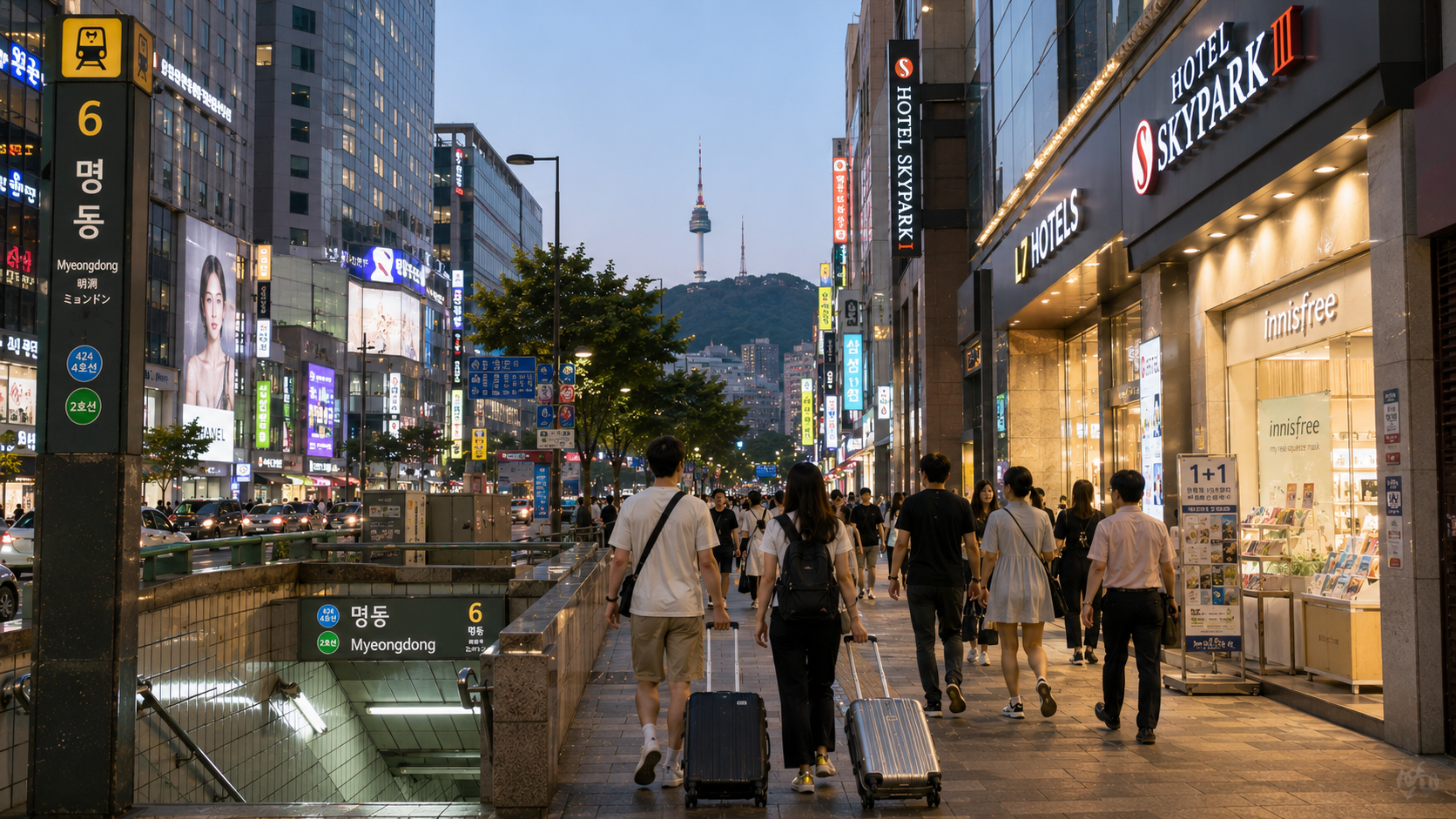
Myeongdong (명동) is a sensible default when you want to see a broad range of Seoul without studying the transport map every morning. Myeongdong Station is on Subway Line 4, while Euljiro 1-ga and Euljiro 3-ga provide access to Line 2 and, at Euljiro 3-ga, Line 3.
This positioning works well for visits to Namdaemun Market, Namsan, City Hall, Deoksugung Palace, Cheonggyecheon Stream, Dongdaemun, and the Jongno palace district. It is also possible to walk to several central attractions, although Seoul blocks and station transfer corridors can be longer than they appear on a map.
Choose Myeongdong if you want
- A central base for a three- to five-day introductory trip
- Numerous hotels at different service levels
- Restaurants, convenience stores, cosmetics shops, and currency-exchange businesses nearby
- Easy Line 4 access to Seoul Station and Dongdaemun History & Culture Park
- A neighborhood that remains active after normal sightseeing hours
Consider Euljiro instead if you want
Euljiro is immediately north and east of Myeongdong. Staying near Euljiro 1-ga, Euljiro 3-ga, or Chungmuro can provide similar convenience with a somewhat more mixed business and local dining environment. Euljiro 3-ga is particularly useful because Lines 2 and 3 intersect there.
What to watch for
Myeongdong's busiest shopping streets can be crowded, and rooms facing commercial lanes may receive street noise. Some properties described as being in Myeongdong are actually closer to Chungmuro, Hoehyeon, or the slopes below Namsan. That is not necessarily a problem, but check the walking route rather than relying on the neighborhood label.
Travelers with large suitcases should check for hills, stairs, and the nearest elevator-equipped subway entrance. Incheon Airport's official transport information lists a staffed T-Luggage storage and delivery counter at Myeongdong Station, but service conditions should be reconfirmed before use through the official Incheon Airport train and luggage guide.
2. Jongno and Insadong: for palaces and traditional Seoul
Jongno is the stronger choice when your itinerary concentrates on Gyeongbokgung Palace, Changdeokgung Palace, Jongmyo Shrine, Bukchon, Seochon, Insadong, and Gwanghwamun.
Useful station areas include Anguk on Line 3, Jongno 3-ga on Lines 1, 3, and 5, and Gwanghwamun on Line 5. These locations can reduce the amount of daily transport needed because several major historic sites are within walking distance.
Choose Jongno or Insadong if you want
- Early starts at palaces before tour groups arrive
- Traditional streets, galleries, tea shops, and smaller restaurants nearby
- A more historic setting than Myeongdong or Gangnam
- Access to multiple subway lines, especially around Jongno 3-ga
Anguk is convenient for Bukchon and Insadong, but accommodation on the northern side may involve slopes. Jongno 3-ga is flatter and better connected, although its atmosphere varies considerably from block to block. Gwanghwamun has broad avenues and business hotels but may feel quiet after offices close.
Do not assume that a hanok, meaning a traditional Korean house, provides standard hotel facilities. Before reserving, confirm whether the room has a private bathroom, a bed or floor bedding, sound insulation, luggage storage, and late check-in. Traditional architecture can involve steps, narrow doors, low ceilings, and limited accessibility.
3. Hongdae: for nightlife and convenient airport access
Hongdae (홍대), centered around Hongik University Station, is one of the most convenient western-Seoul bases. The station connects with Subway Line 2, the Gyeongui-Jungang Line, and the all-stop Airport Railroad, usually called AREX.
The direct all-stop airport rail connection is useful, but confirm that your accommodation is genuinely close to the AREX section of Hongik University Station. The station complex is large, and a property advertised as being in Hongdae may be a substantial walk from the most useful entrance.
Choose Hongdae if you want
- Evening restaurants, bars, live performances, shopping, and cafés
- A social atmosphere suitable for solo travelers and students
- Direct all-stop rail access from Incheon International Airport
- Line 2 access to City Hall, Euljiro, Gangnam, and other major districts
- Guesthouses, hostels, and compact hotels
What to watch for
Hongdae can remain noisy late into the night, particularly near busy pedestrian streets and clubs. For easier sleep, look north of the station near Yeonnam-dong or farther from the principal nightlife streets. Hapjeong is another useful alternative, with Lines 2 and 6, but it does not have a direct airport railway station.
The Incheon Airport guide lists a staffed luggage counter in the Airport Railroad connecting passage at Hongik University Station. Availability and delivery deadlines can change, so verify them on the airport's official train and luggage page.
4. Seoul Station: for airport and intercity connections
Staying near Seoul Station is practical when you have an early KTX high-speed train, several day trips outside Seoul, or a simple airport transfer. The station serves AREX, Subway Lines 1 and 4, and major Korail intercity services.
Choose Seoul Station if you want
- Non-stop AREX Express service to Incheon Airport
- Convenient KTX departures for destinations such as Busan
- Quick Line 4 access to Myeongdong and Dongdaemun
- A practical first or final night near transport
The tradeoff is that the immediate station surroundings do not provide the same evening atmosphere as Myeongdong, Hongdae, or Jongno. The station is also a large, multi-level complex. Transfers between mainline trains, subway platforms, and AREX can involve long corridors and elevators.
Check which side of the tracks your hotel is on. A property that looks close on a map may require a longer route through or around the station. Travelers with luggage should prioritize a clearly documented, step-free route.
Current train departure times, fares, and airport check-in eligibility are time-sensitive. Verify them shortly before travel through Incheon International Airport's official transport section and the operator linked there.
5. Gangnam: useful when your plans are south of the river
Gangnam is often treated as one neighborhood, but it covers a large part of southern Seoul. Gangnam Station, Sinnonhyeon, Seolleung, Samseong, and COEX are separate bases with different transport connections.
Choose Gangnam when your trip centers on business meetings, clinics, shopping, concerts, COEX, or restaurants south of the Han River. Gangnam Station has Line 2 and the Shinbundang Line, while Samseong is on Line 2 near COEX.
For a palace-heavy first visit, Gangnam is less efficient. Reaching Gyeongbokgung, Bukchon, Insadong, or Myeongdong generally takes longer and may require transfers. Accommodation can also be spread along wide roads, so being in Gangnam does not automatically mean being close to a subway entrance.
6. Jamsil: for families and east-Seoul attractions
Jamsil is a reasonable base for Lotte World, Seokchon Lake, major shopping facilities, sporting events, and attractions in eastern Seoul. Jamsil Station is served by Lines 2 and 8.
It suits families who plan to spend a substantial part of the trip in this district. It is less suitable for travelers whose daily schedule revolves around palaces, traditional markets, and western Seoul. Check event calendars before booking because concerts, sports fixtures, and festivals can affect crowds and room availability.
7. Itaewon and Hannam: for international dining and nightlife
Itaewon is known for internationally oriented restaurants, bars, and nightlife. Itaewon Station is on Line 6, and nearby areas include Noksapyeong, Hannam, and parts of Yongsan.
The district is geographically central, but it does not offer direct airport rail access. Reaching many major attractions requires a transfer or a bus. Terrain is another concern: side streets can be steep, and properties described as close to the station may sit uphill.
Choose Itaewon when its dining and evening scene is a central part of your trip. Do not select it solely because it appears near the middle of Seoul on a map.
How to choose your exact hotel location
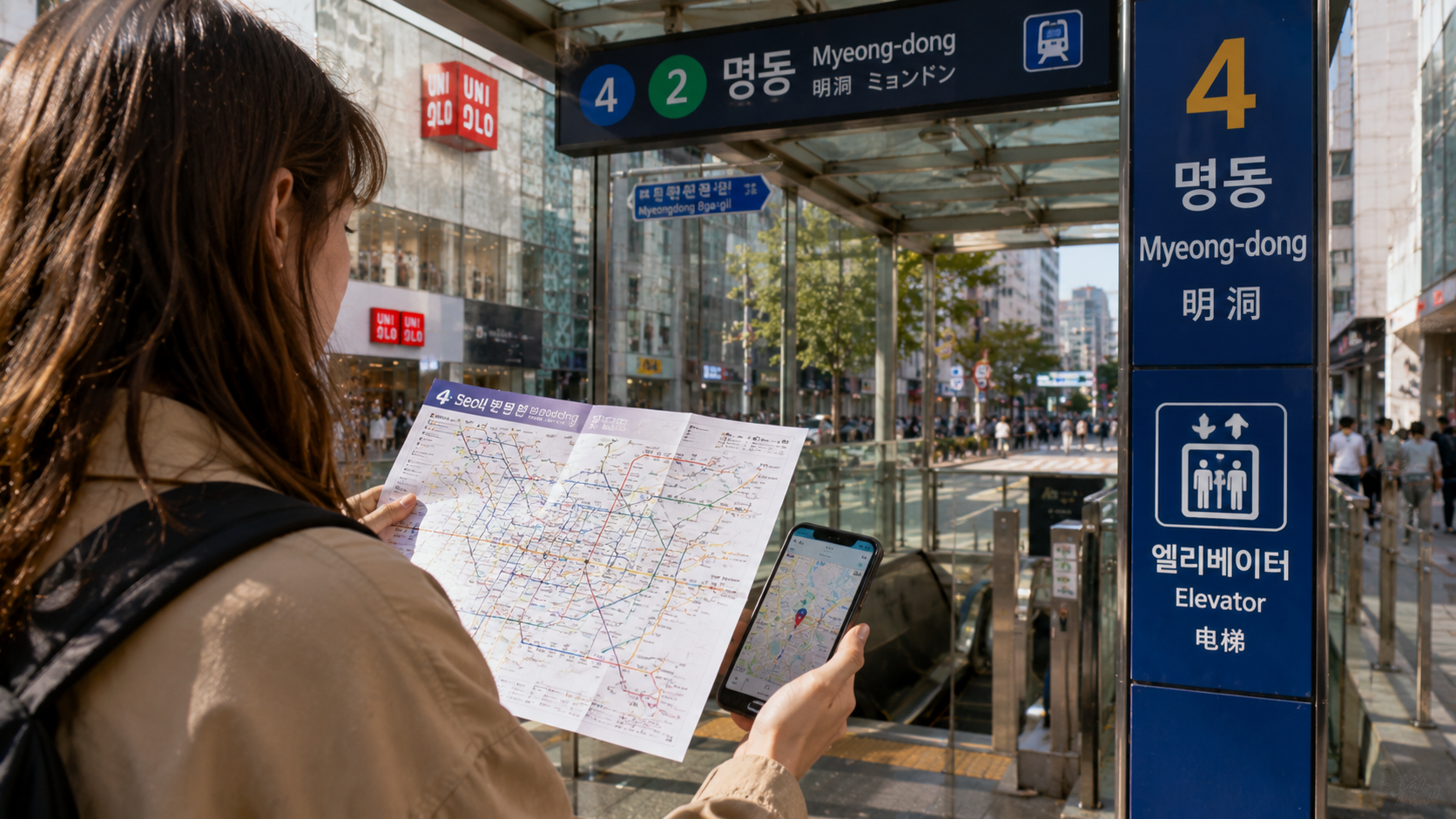
The station matters more than the district name. Use this process before paying:
- Enter the hotel's full Korean or English address in Naver Map or KakaoMap.
- Find the nearest subway entrance, not only the station center.
- Check the walking route for slopes, stairs, underpasses, and major road crossings.
- Confirm which subway lines serve that station and whether your main journeys require transfers.
- Look for an elevator symbol if you use a wheelchair, stroller, or heavy luggage.
- Read recent reviews specifically for noise, room size, air conditioning, heating, and bathroom layout.
- Confirm reception hours and late-arrival procedures directly with the property.
Seoul's city government notes that subway ticket machines offer multiple language settings and that public transportation cards can be used across buses and subways. Current instructions are available in the Seoul Metropolitan Government public transportation guide.
Booking details that surprise first-time visitors
Room size
Central Seoul hotel rooms can be compact. Check the stated floor area and guest photos, especially when two travelers have large suitcases. A double bed does not guarantee enough space to open two bags.
Bathrooms
Some inexpensive rooms have wet-room bathrooms in which the shower is not separated from the toilet. Confirm the layout if this matters to you.
Air conditioning and heating
Buildings may operate centralized heating or cooling seasonally. Ask whether guests can control the room temperature during your travel dates.
Check-in and luggage storage
Small guesthouses may not have 24-hour reception. Confirm whether luggage can be stored before check-in or after checkout and whether late self-check-in requires a Korean phone number or messaging app.
Hotel classification
A property's marketing description is not necessarily an official rating. Seoul publishes accommodation information and classified-hotel listings through its official accommodation guide. Verify the individual property and cancellation terms rather than choosing by stars alone.
Transport pass note
As verified on June 11, 2026, Seoul's physical Climate Card costs an additional KRW 3,000, with short-term passes priced at KRW 5,000 for one day, KRW 8,000 for two days, KRW 10,000 for three days, KRW 15,000 for five days, and KRW 20,000 for seven days. International credit and debit cards can be used to purchase and recharge eligible short-term passes at supported machines.
Coverage is not identical to the entire metropolitan rail network. In particular, the official rules state that airport passengers may use the card to get off at Incheon Airport but cannot begin a journey there with it. Check the latest coverage and payment rules on the official Seoul Climate Card page before deciding whether it suits your itinerary.
What to check before you go
- The exact station, exit number, and walking route to your accommodation
- Elevator availability at both your arrival station and preferred exit
- Airport train or limousine-bus operating times for your flight date
- Check-in deadline and reception hours
- Private versus shared bathroom
- Bed type, room area, and luggage space
- Noise reports for rooms facing nightlife streets or major roads
- Cancellation, deposit, and local tax conditions
- Laundry availability for stays longer than several days
- Whether breakfast accommodates dietary or allergy requirements
- Current transport disruptions and major events near the hotel
FAQ
Is Myeongdong or Hongdae better for a first visit?
Myeongdong is usually better for a sightseeing-focused first trip because it is closer to many central landmarks. Hongdae is better for nightlife, a younger atmosphere, and direct all-stop AREX access from Incheon Airport.
How close should a hotel be to the subway?
A genuine five- to ten-minute walk is convenient. Check the route yourself because booking sites may measure straight-line distance or use the center of a large station complex.
Should I stay north or south of the Han River?
Most classic first-visit sights are north of the river, including the principal royal palaces, Bukchon, Insadong, Myeongdong, and traditional central markets. Stay south when Gangnam, Jamsil, COEX, business appointments, or specific events dominate your schedule.
Which area is easiest with heavy luggage?
Seoul Station and Hongdae have direct airport railway connections, but both station complexes are large. A hotel beside an elevator-equipped entrance can be easier than one that is technically closer but requires stairs. An airport limousine bus may be more practical when it stops near your hotel, but routes and schedules must be checked for the travel date.
The practical choice
For a typical first trip, begin by searching within walking distance of Myeongdong, Euljiro 1-ga, Euljiro 3-ga, or Chungmuro Station. Compare those options with Anguk or Jongno 3-ga if historic Seoul is your priority, and with Hongik University Station if airport access and nightlife matter more.
Before booking, place your planned attractions on a map and test three representative journeys. The accommodation that removes a transfer or a difficult walk from each day will usually be more useful than a cheaper room in a broadly advertised neighborhood.
Sources
- Seoul Metropolitan Government public transportation guide
- Seoul Metropolitan Government accommodation guide
- Seoul Metropolitan Government Climate Card information
- Incheon International Airport official transport guide
- Incheon Airport train and luggage-service information
- Official Tmoney English website